Tuesday, 6 September 2016

Venice and Soriano


We had a great trip that was smooth and surprise free. Venice was our favourite, the delightful
boutique hotel, Hotel Bella Venezia, was quite wonderful, its location was perfect and the rooms were very luxurious.  Their breakfasts were amazing: coffee got sent from the bar rather than from the machine, just because the server took a liking to me.  We loved the Venetian glass and brought home some beads as well as three whisper light Italian linen dresses!   One cannot get a bad meal in Italy.  In Florence the  Uffizi  got checked off our bucket list.  Our last stop, Soriano, was a perfect rest, the scenery was stunning, especially from our window, of Castello Orsini.  With no car, we walked everywhere and found it to be a very walkable town, even though there were times we
were dodging the traffic of teeny cars and delivery trucks.  The walk up and down the mountain kept the pounds off!
We learned from a guide at the Orsini Castle that the houses all jammed up against the castle were configured that way not just for protection of the plebeians (who wouldn't have far to escape to castle  in case of attack), but so that said castle would be easier to defend,  what with all those twisting alleys and pathways.  

Tuesday, 16 August 2016

Almshouses in Amsterdam


Amsterdam is a popular tourist destination for North Americans and Europeans. Even though many of the streets are only for pedestrians they are still crowded and at times chaotic. One day while walking on the Kalverstraat my friend showed me a massive door but on that day it was locked.
Recently we were able to gain entrance and explore the Begijnhof. Initially the Begijnhof was established in the late 1300’s as a residence for lay religious women (differing form nuns in that they did not take vows). Similar Almshouses (Hofjes) were built during the 17th century in the Jordan district to shelter the widows of sailors.

Entering the courtyards of these residences you generally find a cluster of twelve apartments around a central garden and you forget that you are in a city. While there are twenty one of these Horfjes still managed by the local government in the Jordaan district they are private homes so access to these areas occurs rarely. As a tourist I feel quite fortunate to have seen three.


Tuesday, 9 August 2016

Volcanos


We have learned to fear volcanos: they emit gases, erupt lava and occasionally explode. In many cultures they have been your “go to” place for human sacrifice. Nicaragua is a country that straddles two tectonic plates and is part of the Pacific Ring of Fire: you can literally see the chain of cones. Volcanos in this country preside over the landscape and offer sanctuaries of biodiversity for plant and animal species, dormant craters act as reservoirs and porous rock filters water for the farms below.

The Mombacho Volcano features a cloud rainforest at 1150m with hiking trails that people can enjoy guided or independently. Downhill from the primary forest you find the coffee growing area and can either learn about the harvesting process or go zip lining. The Canopy Zip Line tour is set over seven legs of varying lengths and difficulty. As a first time zip liner rather than feel intimidated I felt a connection to the rain forest environment.

Masaya Volcano is much more easily accessed: it is an active site and the cone has been deforested from an eruption in the 2013. Drivers can park within twenty feet of the rim to look into its active caldera. While there are trails around the craters, exploring the area depends upon wind direction because the gases emitted can make you sick after a while.

East of Leon, Casa Negro Volcano is a site for sand boarding (like snow-boarding but on volcanic sand). While ascending the cone, boarders get to enjoy vistas of the surrounding peaks. It felt very primal…after reaching the top I got to run the rim trail before descending on my board. Sand boarding involves wearing coveralls, heavy gloves and a visor that protect you from the coarse sand. It was much easier than I expected: the slope looks steep but the sand is deep and offers some resistance for controlling your speed.


My experience at all three locations felt very “elemental”. Volcanos are a force of nature but the landscapes they generate are quite inspiring. Perhaps “experiencing life on the edge” isn’t an entirely bad thing.

Tuesday, 2 August 2016

Travelling to El Salvador

I recently had the opportunity to visit Suchitoto in Northern El Salvador, Puerto Barillas on Jiquilisco Bay and the country’s sun coast. During my time there I saw nature preserves, heritage architecture and expansive beaches. In my opinion there are a lot of contrasts and while I felt intimidated by the razor wire and presence of guns many of the people in the hospitality industry were genuinely warm. El Salvador has a great potential for tourism in the next decade.

Suchitoto overlooks a man-made lake which carries the same name. Traditional Spanish homes mark the cobble stone streets of this colonial city.  During the civil war of the 1980’s the town sustained heavy bombing and many people deserted their homes. The government is now working to revive the area as a tourist destination by restoring and repurposing these abandoned buildings as hotels and restaurants. While walking the streets we visited the Iglesia Santa Lucia which is renowned for its interior woodwork and saw a woman selling bread from a large basket that was perched on her head. The area also hosts avian tourists: from my terrace at the La Posada de Suchitlán and I saw a variety of birds and insects then during our afternoon tour of Lake Suchitoto we went to a massive colony of egrets and cormorants.


In contrast Jiquilisco Bay is a mangrove wetland which offers protection to a diverse array of species. On my boat trip to the turtle conservation project I saw a crocodile, spoon bills and a tiger heron.  Guests staying at Puerto Barillas have the opportunity to discover the bay’s wildlife through boat tours, fishing excursions and kayak rentals. Our group took part in a turtle conservation project that capture, measures and tags Hawksbill turtles. Part of the Eastern Pacific Hawksbill Initiative, this project offers visitors the opportunity to participate in their volunteer program http://www.hawksbill.org/get-involved/volunteer/ .  


The Costa del Sol Beach spans a distance of twelve kilometres and is popular with surfers. The evening I was there the water was warm and the waves were great for body surfing but also a little intimidating. This area is located thirty-five kilometres from San Salvador Airport making it a nice stopover point for passengers transiting the country.
Currently the destination has some infrastructure issues: with the exception of the Costa del Sol most tourist areas have poor road access and English is not well comprehended even within the hospitality industry. Personal security was always at the back of my mind: even though a recent customer got a local taxi at the airport I recommend that visitors pre arrange ground transportation before arrival.

Tuesday, 26 July 2016

Jordaan Food Tour


While travel is about discovering new places and customs it also helps you learn things about yourself. Food tours provide a great opportunity to try different food and learn how a city developed in relationship to other cultures. Recently I enjoyed a food tour of the Jordan area in Amsterdam. Our trip featured some stereotypical Dutch food but also cuisine inspired by its colonies. Our first stop was at a traditional “brown café” which is a pub historically decorated in dark woods.  After meeting our group and enjoying poffertjes with coffee our guide lead us through the area to different shops and restaurants where we sampled pastries, herring, kibbling, cheeses and bitterballen. I expected to sample  Indonesian Food however our tour included a Suriname restaurant: this cuisine had been developed by Indonesians when they immigrated to Suriname. The fusion of cultures made for a great food experience.

Tuesday, 19 July 2016

Brú na Bóinne


New Grange
The Neolithic Period commenced about 10000BC and ended between 4500-200BC. As a reference this is the period in which Jericho was built and Stonehenge erected: it was also the era during which passage tombs were created beside the Boyne River in Ireland. Today a world heritage site has been established at Brú na Bóinne which features these tombs: two of which are accessible to visitors. Knowth and New Grange were both built about 3200BC and served as ceremonial tombs that incorporated astronomical clocks into their designs. In the case of New Grange that calendar function continues today: the passage of that structure is designed so that light only enters the center of the tomb on the winter solstice. This feature allowed farmers to determine when spring would occur so that they could commence planting crops.
Inner Passage at Knowth


The tombs are similar in size but differ from each other in two ways. Knowth has one passage oriented to the east with a second to the west and most of the kerbstones around its perimeter have been decorated with designs. New Grange is slightly smaller with only one passage (facing to the south) and the front of it was decorated with a design of black and white stones.

The presentation at New Grange includes a lighting component that mimics the entry of light into the passage which occurs at the winter equinox. Starting in darkness a flickering beam stretches across the chamber and you visualize light as a dynamic force and understand the relevance of the sun in Neolithic culture.

We may marvel at the tombs because of the methods and labour used to construct them however their carved kerbstones make them significant. What you see at Brú na Bóinne represents the highest concentration of megalithic art in Europe. The meanings of the symbols are for the most part a mystery but one has been interpreted as a calendar and a second as an astronomical map.
Kerb Stone at New Grange

Tuesday, 12 July 2016

Hoorn


European cities get crowded during the summer months and Amsterdam is one example: streets are congested and hotels become expensive. Hoorn, located thirty five kilometres north of city is a viable alternative for exploring the Netherlands. Day trips to Amsterdam are feasible but the town itself features historic buildings, traditional squares and outdoor cafes. Its smaller size makes it easier to connect with people: on my third day the residents made me feel like a local. The area is a great location for cycling or walking: cars are prohibited on several of its streets and the Grote Noord is exclusively a pedestrian thorough fare. Hoorn became a city in 1357 and its seaport served as a base for the Dutch East India Trading Company. Touring the area you can see the old locks to the city’s canals and two towers that served as part of the original city walls. Many of the buildings built during the Elizabethan Era still are in use
including the Maria Tower which can be rented as tourist accommodation. Two dikes now separate Hoorn from the sea and it now functions as an inland port on the Markermeer. On Saturdays the town hosts a large Farmer’s market where shoppers can explore a wide variety of food and products.

Friday, 8 July 2016

The Antrim Coast

The Antrim Coast of Northern Ireland extends between Ballintoy and Portrush. Prior to 1998 political issues discouraged tourism into this area and it remains relatively rural. On the day I travelled the A2 along its coastal route the weather was sunny and we had clear views of Rathlin Island and the Hebrides of Scotland. Many of the scenes from Game of Thrones are filmed in the area including the sites of Dark Hedges and the Carrick-A-Rede Rope Bridge. It’s popularity has attracted tourists to the area and a visit to Dark Hedges, an avenue of mature Beach trees that interconnect over the road way, should be taken either early morning or late evening, a second location equally popularized is Carrick-A-Rede Rope Bridge located east of Ballintoy. The one kilometre path to the bridge is scenic but remember that you need to buy a ticket at the trailhead before making the hike otherwise you are not able to cross to the island. Originally fishermen crossed to Carrick-A-Rede to harvest salmon but now it is managed by the National Trust as a tourist attraction. The village of Ballintoy is nearby and looks like a great spot for cyclists or hikers to stay in a bed and breakfast or enjoy a local pub.
 
Seven miles away the National Trust manages a visitor’s center at the Giant’s Causeway. The building itself has won an architectural award: part of it is set underground so that it is inconspicuous against the cliffs and its basalt columns echo the geology of the area. To view the Giant’s Causeway visitors have to walk 800 meters from the reception down the hill to Port Noffer. Ulsterbus offers service between the two points during the high season so that tourists may avoid trekking up or down the hill. I was impressed by the center’s interpretive displays which traced the theories, fact and fiction of this landform.

Our final call was a photo stop at Dunluce Castle east of Portrush.  This site is also managed by National Trust: most of the room have fallen in but visitors can view it’s two remaining towers and walk down to the Mermaids Cave beneath the stronghold (another setting used in Game of Thrones).

Monday, 4 July 2016

Trent Canal Hastings to Campbellford


My first experiences on the Trent Canal were when I visited cousins in Hastings and the lock keepers would let us help turn the arms which opened and closed the lock gates. Recently friends invited me to join them on their boat for the trip from Hastings to Campbellford. These communities are also connected by the Trans Canada trail which gave me the opportunity to cycle to Hastings without worrying about traffic.
 
Trans Canada Trail

The trail itself is beautiful: it starts just behind the Canadian Tire and travels on the old rail bed to the bridge in Hastings. The surface is stony with some packed earth areas, small bridges extend over creeks and it passes through a huge culvert under Highway #35. I saw a lot of birds as while transiting fields, woods and at one spot a barnyard. The day was warm but a lot of the trial is shaded. Mountain bike tires are necessary: there is loose gravel and road tires are ineffective.

Lock 15 - Healey Falls
Going down the canal was a blast. Hastings is at Lock 18 while Campbellford is located below Lock 13 and the drop varies at the different locations. Our most significant descent were the double locks at Healey Falls with a drop of twenty four feet: it was bizarre to see the base of the canal appear as we dropped below the eight foot depth. Staff at each lock were good about taking the lines to secure our boat and often would stop their routine to chat. En route we saw lakes and farmland: most of the route is secluded and you only find shops and restaurants in the larger towns of Campbellford and Hastings.


Tuesday, 28 June 2016

Cycling in the Netherlands


There are more bicycles than people in the Netherlands and for many in that country cycling is their primary transport. I noticed while travelling that bike riders use a dedicated lane  which is  often separated from the main roadway by a curb and they have the right of way in traffic roundabouts. Cycling is popular because the terrain is flat, communities are located close to each other and car parking space is limited. In fact many towns exclude access to cars in their downtown areas.
Dedicated Cycling Lanes between Roadway and Canal
For visitors who wish to explore the Netherlands by bicycle the tourist board has designed a system of maps with posted highway routes that will guide you through an area and in the off hours passengers can take their bikes onto trains (for an additional fee). In Amsterdam I noticed that most rental bikes were older designs but once you get outside of the cities you can rent performance models. Locating yourself in Hoorn, Alkmaar or Marken puts you within an easy distance of several communities for day trips.  One excursion which looked appealing was travelling by steam train from Hoorn to Medemblik, then steamship to Ankhuisen and cycle back to Hoorn.

Wednesday, 22 June 2016

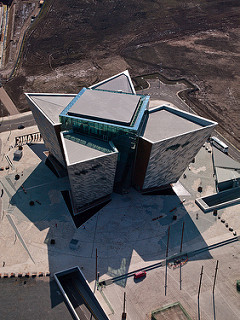
Titanic Belfast


We are all familiar with the Titanic: an unsinkable ship that went down on its maiden voyage in April of 1912. That crossing hosted aristocrats, businessmen and politicians so the tragedy had a significant impact upon the world. One century later people are still fascinated with the disaster: there are touring shows that display its artefacts and Cobh Harbour in Ireland marks the last Port of Call for the Titanic with an audio/video experience. Years of reading stories and watching movies about its sinking made the story boring to me.

My recent visit to the Titanic Experience in Belfast changed that feeling because the presentation is broad in scope. Titanic Belfast showcases the phenomenon of Titanic organized into ten galleries featuring different aspects of the voyage, ship building and nautical protocols. The first display, Boomtown Belfast, caught my interest and my attention continued to the last exhibit which details current technologies used to explore the ocean.


Guests start their tour by learning about Ireland’s changing economy prior to shipbuilding and the depth of poverty that led people to leave the country. This display included an activity which showed where the emigrants relocated to in Canada and made me feel connected to their experiences. From these initial themes stories unfold as you proceed through the site providing you with an encounter rather than a display. This exhibit not only educated me about Titanic but served as a good introduction to the contemporary history of Belfast and Ireland.

Friday, 20 November 2015

San Juan del Sur


Coloured Buildings
San Juan del Sur has been known as a fishing village/surf haven for a number of years and is now a trending tourist destination. It’s location on the pacific coast of Nicaragua makes it a nice base for people who wish to explore the various beaches in the area.  The appeal of day trips along the coast has attracted Cruise ships to include it as a Port of Call and a number of boutique hotels have opened in the town. The day I visited the area I felt like I had dropped into the 1950’s as I sipped my “Tona” (the local beer) however the community has been a travel destination for a very long time.
 

Hotel Victoriano
During the mid 1800s people travelling between California and the Eastern seaboard often crossed via Nicaragua rather than trek overland on a route created and managed by the Cornelius Vanderbilt. San Juan del Sur was a transit point on the Pacific and The Hotel Victoriano still includes Mark Twain as one of its famous occupants.  Downtown wooden buildings painted in a variety of colours retreat from the shoreline and are reminiscent of the Mediterranean. As you approach the water you pass the Malecon which follows the curve of the Bay and find restaurants, surf shops and charter boat services before arriving at the beach.
The day that I was there we enjoyed lunch at Restaurant El Timon which is located at the high tide mark in the middle of the Bay. The open air location offers inviting views of the ocean where surfers were riding easy swells and a mixture of yachts and fishing boats were tendered further out. Similar to Rio the area has a statue “Christ of Mercy” located on a high cliff at its north end. Our meals were presented nicely and prices for most entrées were about 350.00 Córdobas, or 16.00 Canadian.

I feel that this area is going to become popular: Nicaragua has a low cost of living that appeals to budget travellers and retirees are establishing expat communities on the hills above the town. There are a number of undeveloped beaches in the district so sooner or later resorts will be built. For now you may want to beat the crowd and experience its funky atmosphere.

Wednesday, 18 November 2015

Aqua Wellness Resort


Wellness-the state of being in good physical and mental health.

I have never been truly clear on the concept of a Wellness Vacation. To me wellness is a physical and mental state, a conscious pursuit but not a travel product. Many resorts include “wellness” in their spa programs as an option on a list of treatments however a holistic approach like that at The Aqua Wellness Resort in Nicaragua seems to meet my expectation of a wellness destination.


This property has been physically constructed so that it blends in with the tropical forest and it was only after a long tour of the resort that I realized it had fifty rooms. Villa units are suspended above the jungle floor to minimize their environmental impact and connected with the common areas by a network of crushed lava pathways. As a result of these efforts turtles nest on their beach and often Howler monkeys populate the trees at night.
 
Guest accommodations are located on the side of a steep hill giving each room privacy and a view of the either the bay or the forest and inside the units beds are placed in front of the window so you get to enjoy the natural setting even at night. Walking over one of the wooden bridges I felt like I was at a cottage or a calm retreat. One concession to luxury I noticed was that many units featured individual plunge pools overlooking the bay.


Food served at the resort is produced locally and leans to vegetarian appetites so while the menu depends on what is in season you know that the food will be fresh. Our host, Jose Menendez, stated that the resort’s staff philosophy was unobtrusive mindful service offered with a genuine desire to enhance the guest’s experience. Even during our short tour we experienced that attentiveness: upon arrival we were all provided with cool towels and offered refreshments that were caringly presented.
 

The physical and social environment at the Aqua Wellness Resort are conducive to that pursuit of Wellness and can help guests find that self-awareness to carry home with them after their stay. It emphasizes the statement that travel enhances the traveller…

Ephesus

The day started with breakfast on the roof top terrace.  Then three of us walked to the Isa Bey Mosque, built in 1375 and still in use while being restored.  There are massive chandeliers with electricity saving bulbs and the columns were salvaged from the ruins of  Ephesus.  We put on black and white geometric patterned chadors and head scarves. The Imam gave us a tour and said  he does not like the machine made carpet.  His son made the tiles in the store which raises money for the restoration of the mosque.  Of course I bought one and told him Inshallah I will be back in Turkey one day.  A surreal experience.

Then a shoeshine man started cleaning my shoes despite my protests. I gave him three lira, he wanted 20, I said 5, we agreed on 10 as I snatched back my 5 before it became 15.  So $5 for a shoeshine and lesson learned to not slow down while saying no.  Sellers can sometimes be persistent to the point of being aggressive.  We take it in stride.

The basilica of St John and the Citadel are really something, ruins but requires less imagination to envision than Troy.  You can see forever from the site.

I cannot even describe Ephesus so will not attempt to.  It is huge and fascinating with a population of 250,000 at its peak and everything was clad in blinding white marble. We went at 3:00 pm rather than at 9:00 am with the thousands of cruise ship tourists.  I have about 100 photos.  It took about three hours to walk through.  It is incredible.

All in all it was a wonderful day ending with a walk around a small country village, apple tea at the cafe, then supper in the garden of a Turkish family.  He is a guide, she restores antiquities.  They have a mission to preserve village life.  Everything was homemade, organic, fresh and vegetarian. The olives were from their trees, homemade olive oil, unbelievable salads, delicious pea stew and an eggplant dish that I had two helpings of even though I am not a huge fan of eggplant.  I have the recipe.  Shredded carrots stir fried in olive oil and mixed with yoghurt.....I cleaned the plate.  Dessert was fresh honeydew melon and watermelon.  This is a new venture and we were the first group. It will be a success. 

Hierapolis and Pamukkale

Turkey has an array of stray animals: cats (there cannot possibly be a single mouse in Turkey), dogs (which are tagged, neutered and vaccinated for rabies etc) and even fowl.  We found ducks and roosters in the strangest places.....like the driveway of our last hotel where one duck decided to do his own call to prayer about 3:00 am. Right under our window.

Today we exchanged peach orchards for fig orchards; the best figs are all exported. Our driver stopped the bus in a village, jumped out and returned five minutes later with a huge bag of freshly picked cherries for us all.  We really like Genghis and will miss him after he drops us at the airport for our flight to Istanbul.  

The ruins of both the necropolis and the town of Hierapolis were fascinating.  The calcium carbonate cliffs of Pamukkale are downright strange. We walked down the hillside barefoot in the gushing water which flowed through six pools.

Lots of construction in Turkey, especially apartment buildings, 3-4 stories in smaller areas and buildings like the Marilyn Monroe one in Mississauga in the cities.  They are needed for the growing population if under 30's.  With 75 million people and so mountainous, most people live in apartments. Some buildings have what looks like bread ovens built into the balconies.  They are actually coal bar-b-ques!  Western Turkey is incredibly fertile, sort of like southwestern Ontario.  The fruit has been amazing.

Monday, 16 November 2015

November 16, Granada, Nicaragua

Granada: Reinvention of a city

We all have heard the catch phrase “reinvention” and there are many examples of people who reinvented themselves (Madonna), companies (National Geographic) or even Countries (China). The term sounds progressive and trendy but in some cases it is simply a refining process. For instance the Nicaraguan city of Granada is undergoing its fourth reincarnation after enduring civil and economic hardship. The town site was originally settled by Cordoba in the year of 1524 on the northern shore of Lake Nicaragua. Its location ended a journey often travelled by conquistadors, priests and pirates en route from Caribbean up the Rio De San Juan and to the Pacific. This easy access made the city a natural target for privateers and it was razed three times.
 
Lake Nicaragua close to Granada

While Buccaneers no longer threaten the country a civil war (Oliver North and the Contra-Tehran Affair) occurred from 1983 to 1988 and was followed by a US embargo which crippled their economy. Our tour guide to the area told us that Canada aided the Nicaragua during that period by circumventing the embargo and supplying Nicaragua with grain. He said that the people’s motto at the time was “bread, but with dignity”.

The country is now rebuilding and Granada was designated as a UNESCO World Heritage Site in 2003. This city exemplifies a traditional Spanish settlement not only by its buildings but also by the layout of the streets: a large central square dominated by a Cathedral and administrative offices with streets leading off at right angles.  Hotels and restaurants now occupy the spaces that housed wealthy families and being in these establishments can give you a feel for what life must have been like during the 1700’s.

Parque Central with Granada Cathedral in the back ground
Buildings are restored to the colonial style of the seventeenth century and must adhere to strict standards: high ceilings, tall doors and interior courtyards but no building can exceed a height of two stories. Walls are constructed of adobe and roofs must be tiled over a supporting framework of Castia cane. At one of the reconstructed hotels I visited rooms had no exterior windows because itwas not consistent with the Colonial Style. One point in which the restoration deviates from history is that residents are allowed use a wide palate of colours to paint their homes giving the community a very tropical vibe.


This re-creation has attracted tourists to the area who are drawn by its history and surrounding landscape. Many of these visitors found the cost of living to be low relative to their home country and now form a large expatriate community. Both outcomes have brought money into the locale and further restorations including La Polvora Fortress are now underway. Granada is an example of successful reinvention but that is the value of experience.

La Polvora Fortress


Tuesday, 1 September 2015

Sail - Tall Ship Celebration

Every five years "Sail" is hosted by many European Port Cities. In Amsterdam the event is highly promoted and involves charter, vacation and educational boats. The congregation of heritage sailing ships involves parades, dragon boat teams and celebrates craft of a different age. I had the opportunity to preview some of the vessels when they docked in Ijmuiden.

Minerva

Saturday, 29 August 2015

Bus Service in the Netherlands

In the Netherlands most bus schedules can be accessed on the Internet. At bus stops you will see signs which display when the bus is expected to arrive when the next one is coming. Please be aware that drivers will not stop unless you signal (wave them) down. You are able to pay for your fares on the bus and the drivers are quite friendly and able to speak several languages. Wi-Fi is free on the bus and you simply collecting on the mobile_connextion Internet Provider. The sign in page would be pulled up to appear you agree to the terms and conditions. See your stop press one of the signaling buttons and the driver will pull over at the stop.

Wednesday, 26 August 2015

European Baggage Lockers

Most major rail stations in Europe have banks of lockers where you can leave your luggage while exploring a city. Usually there are differing sizes of lockers available at different prices. You need to pay by credit card or some only work with coins. You simply put your luggage in a locker close the door and pay the required fee: a barcoded receipt will be generated which you carry with you until you want to call reclaim your luggage
 
Locker Rental Panel

Monday, 24 August 2015

A Garbage Truck in the Red Light District

Cyclists in Amsterdam are wild: through a bizarre mixture of traffic planning, legislation and momentum bikes often take the right of way on the city's streets. Against my host's recommendations I decided to try a bicycle tour with Mike's Bike Tours of Amsterdam  (http://www.mikesbiketoursamsterdam.com/) my reasoning being that having completed a couple triathlons I had the aggressiveness to navigate the traffic.

Our tour leader was Mike 2 who knows the city well and is quite personable. Our first stop was Leidseplein which is an entertainment center criss-crossed with tram tracks. Everyone navigated the square successfully and proceeded to Vondelpark and then to the Museumplein (an area surrounded my art museums). We were equipped with seven speed bikes which worked for the terrain we cycled: while the city is flat some of the bridges offer the challenge of an incline. Eventually we arrived at  the Little Bridge where a barge was dredging bicycles up from the canal and illustrated the fact that bikes are frequently stolen then dumped.
De Waag - One of Amsterdam's Medeaval Gates
Proceeding past the Hermitage and Zoo we ended up at the Scheepvaartmuseum (it is a naval institution not zoological) which is close to Centraal Station. At this point traffic became very congested and we took a side street through the red light district with it's mass of pedestrians. Rather than invite hostility of prostitutes in the area we were advised to glance not stare (or take photos). The streets narrowed and unfortunately we got snagged behind a garbage truck that was breaking down drywall. This was where the trip ground to a halt: while Mike was able to get some of the participants through the bottleneck eventually the workers would not allow the rest of the group to pass. Our guide eventually found a detour but for fifteen minutes our tourist site was the sanitation truck.

Dam Square

 
Our tour continued through the packed streets of Dam Square, past the Anne Frank House and ended at the Noorderkerk (North Church) in the Jordaan District. I found that I ended the tour with a better understanding of Amsterdam and a the knowledge about where in the city cycling works best.
Delft Tower close to the Flower Market